Hello. It’s December 7, 2017. I’m Lin Thompson, and this is BookWeek- Money. Crime. Lust. And First Editions, coming to you from our new Facebook home, the BookWeek page.
We’ve spun off this program from Rare Book Cafe’s page- as we did this program from the Cafe show last spring- to sharpen our focus on news in the rare book and collecting world.
The BookWeek page allows us to add news items all through the week, do interviews, and generally- as 19th century Chicago newspaper editor Wilbur Story put it- to print the news and raise hell.
Today we’ve got some auction and museum news ranging from the political to the sublime.
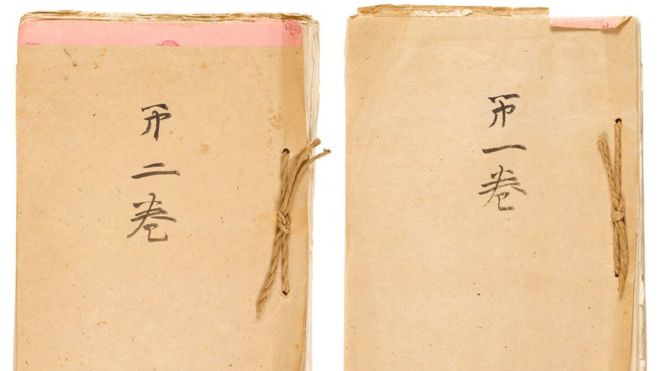
-A memoir by former Japanese Emperor Hirohito about World War Two has been bought by a Japanese surgeon accused of denying the Holocaust and the Nanjing massacre.
Known as the Emperor's Monologue, the memoir chronicles the slide into war until Japan's surrender in August 1945.
Dr Katsuya Takasu paid $275,000 (£205,000) at an auction in New York.
He has described Auschwitz as a "fabrication" but says he is against Nazism.
According to the Simon Wiesenthal Center, Dr Takasu last month was expelled from the American Academy of Cosmetic Surgery in response to his views.
It claimed his social media posts "violate all norms of decency and reveal a person who is a racist anti-Semite and outright lover of Nazism".
Dr Takasu, who often appears on Japanese television, tweeted in 2015 that both the massacre in the Chinese city of Nanjing committed by Japanese troops beginning in late 1937 and the Nazi death camp of Auschwitz were "fabrications".
But he also said that there was "no doubt" that Jews were persecuted by the Nazis and told Reuters news agency on Thursday that his tweets had been intentionally misunderstood.
"If you look at all my tweets, I am clearly against Nazism. But I do highly evaluate the wonderful medicine of that era," he said.
The memoir he purchased is assumed to have been carefully written to absolve the god-like emperor of personal responsibility for the war.
He said he bought it because it carried a message to Japan's people and other royals.
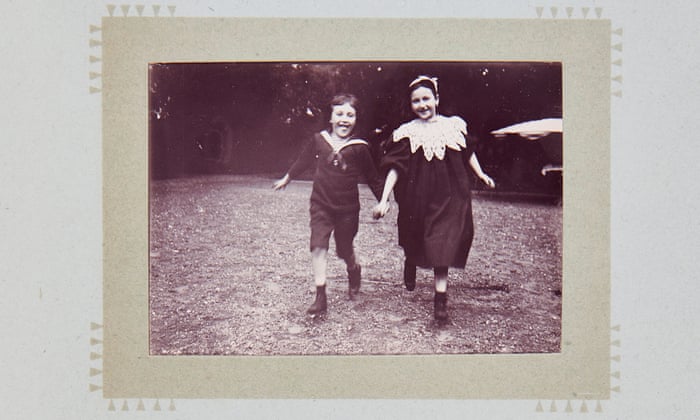
Zola's children, 1897.
-In the eight years before his death in 1902, French author Emile Zola became obsessed with photography, taking thousands of pictures with his 10 cameras and developing them in the basements of his three homes.
The collection, expected to fetch up to $70,000 when it goes under the hammer on Monday evening, belonged to the writer’s grandson, François Émile-Zola, who died in 1989, who inherited it from Zola’s son, Jacques. The auction includes albums, prints, glass plates and photographic equipment as well as white linen laboratory coats embroidered with Zola’s initials.
Much of it was only seen for the first time in 1979 when Emile-Zola published a book, Zola, photographe.
Zola was 54 when he discovered photography; he not only took pictures but also experimented with film development and made his own contact sheets.
The collection includes images of his wife, Alexandrine, and the children he had with his mistress, Jeanne, his favorite model, as well as scenes of Paris in the 1890s and pictures taken during his 11 months in exile in London.

Zola was forced to flee France after being caught up in the Dreyfus affair. In an open letter to the French president, Félix Faure, headlined “J’Accuse…!”, Zola accused army top brass of fixing the trial of Captain Alfred Dreyfus, who was found guilty of spying.

-Letters written by Greta Garbo that provide a rare glimpse into the loneliness that haunted one of the 20th century's most enigmatic Hollywood stars will be auctioned in London next week.
The collection of 36 letters, alongside more than 100 photographs of the reclusive actress, who died in 1990 aged 84, will go under the hammer at Sotheby's on December 12.
The Swedish-American icon, who disappeared from acting and public view in 1941, remained a mythical figure right up until her death, living alone in Manhattan and shunning interviews and invitations.
Spanning several decades but penned primarily in the 1930s and early '40s from Beverly Hills, California, Garbo wrote all the letters to her friend the Swedish countess Marta Wachtmeister.
The correspondence laid bare the inescapable unease that pervaded her life, including her "loneliness, depression, and ill-health, her constant homesickness, and love of the Swedish countryside," according to Sotheby's.
The mood of the letters contrasts sharply with the album of 111 amateur photographs that capture Garbo enjoying life at the castle with the Wachtmeisters, skiing, socializing and playing with animals.
Starring in the 1932 drama "Grand Hotel", she delivered her most famous line: "I want to be alone" -- voted the 30th most memorable movie quote of all time by the American Film Institute.
It seemed this was Garbo's own desire but the letters -- most unsigned, save for one autographed "The Clown" and two others that ended in sketches of female figures -- suggest that once she got her wish, solitary life failed to bring happiness.
"I am almost always alone and talk to myself. I drive to the beach and take walks and that's always marvelous. But that's it," she wrote in 1939, recounting living in Beverly Hills, a place she grew to loathe.
In another letter, dated 20 August 1941, she expressed disappointment at changes made to the plot of "The Two-Faced Woman" which gave Garbo the worst reviews of her career.
"But since I would rather go walking in the country than fight for stories, it will have turned out like it has," she wrote of the film, her last before self-imposed retirement.
The collection of letters and photos are expected to fetch up to $27,000.

-The world's oldest Nobel Prize ever offered at auction — awarded in 1902 to the revered German scholar Theodor Mommsen for Advancements in Literature — will be presented by Heritage Auctions Jan. 7-8 in New York.
The Nobel Prize will cross the block at no reserve during Heritage's annual World Coin Auction held in conjunction with the New York International Numismatic Convention. Awarded a year before his death, the early rare gold medal celebrated Mommsen's contributions and research on ancient Roman civilizations, said Marc Emory, Director of Heritage Auctions' European Operations.
"Since the first Nobel Prize gold medals were awarded in 1901, this is one of the earliest, if not THE earliest Nobel Prize medals ever offered at public auction," Emory said. "Not only is it rare for Nobel Prize gold medals to appear at auction, it is particularly important when one is bestowed on one of humanity's greatest minds."
Mommsen spent his life fascinated with history – especially that of ancient Rome. Mommsen's achievement was Römische Geschichte (History of Rome), a three-volume work published between 1854 and 1856, covering the history of the Roman Republic through Caesar's dictatorship.
He published more than 1,500 works, had 16 children and even left American humorist and author Mark Twain star struck when the two met in 1892.
"Mommsen also laid a critical groundwork in the sphere of Roman numismatics," Emory said, "establishing the Zeitschrift für Numismatik—a journal devoted to Roman coinage whose publications have been cited extensively by The Roman Imperial Coinage, the chief reference in the field. He also published publishing the fundamental Über das Römischen Münzwesens (History of the Roman Coinage), which helped form the foundations of the modern study of numismatics."
Heritage Auctions has sold several Nobel Prize gold medals in recent years, achieving more than $2.2 million for Francis H. C. Crick's Nobel Prize Medal and Nobel Diploma awarded for discoveries in human DNA. Additional medals have realized six-figures auction values, including Francis Peyton Rous's 1966 Nobel Medal for Medicine, which sold for $461,000, Georg Wittig's 1979 Nobel Prize Medal in Chemistry, which sold for $274,000 and Walther Bothe's Nobel Prize for Advancements in Physics, which sold for $129,500.

-On 7 December in New York Christie’s will auction a fascinating selection of books and manuscripts from the library of Martin Greene, offering a tangible connection to some of the most dashing — or foolhardy — adventurers in modern history.
The library of collector and keen mountaineer Martin Greene includes books, atlases, letters and other primary sources from groundbreaking polar and Russian and American expeditions. Collectively they describe narratives of triumph and failure, camaraderie and competition, scientific excellence and raw human courage in exploratory missions undertaken between the 16th and the 20th centuries. See all lots at the Christie’s site.
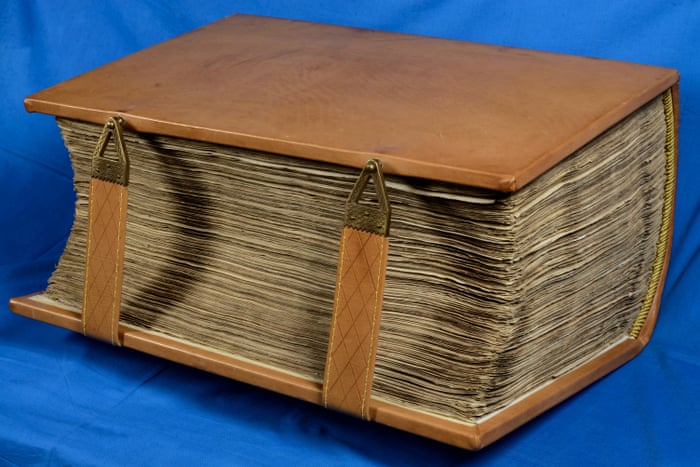
-One of the greatest of all Anglo-Saxon treasures, the oldest complete Latin Bible in existence, is returning to the UK for the first time in 1,302 years.
The Codex Amiatinus is a beautiful and giant Bible produced in Northumbria by pioneering monks in 716 which, on its completion, was taken to Italy as a gift for Pope Gregory II.
On Thursday, the British Library announced it had secured its loan from the Laurentian library in Florence for a landmark exhibition in 2018 on the history, art, literature and culture of Anglo-Saxon England.
“It is the earliest surviving complete Bible in Latin,” said Claire Breay, the library’s head of medieval manuscripts. “It has never been back to Britain in 1,302 years but it is coming back for this exhibition. It is very exciting.”
The Bible is considered one of the most stupendous surviving treasures from Anglo-Saxon England but is not widely known about outside academic circles.
“I’ve been to see it once and it is unbelievable,” said Breay. “Even though I’d read about it and seen photographs, when you actually see the real thing … it is a wonderful, unbelievably impressive manuscript.”
Part of its power is its sheer size. It is nearly half a metre high and weighs more than 34kg (75lb), and more than a thousand animal skins were needed to make its parchment.
It was one of three commissioned by Ceolfrith, the abbot of Wearmouth-Jarrow monastery, and was a mammoth undertaking, said Breay. Of the others, one is lost and another exists in small fragments at the British Library.
Ceolfrith himself was part of the team of monks who took the Bible to Italy, but he never got to see it arrive because he died on the journey, in Burgundy.
There is evidence of it arriving and, at some point, it made its way to the monastery in San Salvatore, Tuscany, before arriving, in the late 18th century, at the Laurentian library where it has remained one of the greatest treasures.
The Codex Amiatinus will go on display alongside the Lindisfarne Gospels and some of the most spectacular illuminated manuscripts that exist anywhere including the Benedictional of St Æthelwold, which includes the earliest surviving image of the three wise men wearing crowns.
Breay said the autumn exhibition would shine light on the sophistication of Anglo-Saxon culture, a period often dismissed as the Dark Ages.
Another coup will be the loan, again from Italy, of an important manuscript of Old English poetry known as the Vercelli Book. Dating from the 10th century, it returns to the UK for the first time and is being lent by the Biblioteca Capitolare in Vercelli.
It is one of four manuscripts known as the Old English Poetic Codices, the others being the British Library’s manuscript of Beowulf, the Junius manuscript at the Bodleian library in Oxford and the Exeter Book from Exeter Cathedral library. All four will be on display together for the first time.
Also on show will be the oldest surviving will left by a woman (Wynflaed), who lists her estates, slaves, horses, tapestries, dresses, headbands, seat cushions, bed curtains, wooden chests, metal cups, jewellery and coins; and the earliest surviving original letter, sent by the bishop of London to the archbishop of Canterbury in 704 or 705, asking permission to attend a meeting to resolve disputes between neighbouring Saxon kingdoms.
Next week: how the American president’s tax law will help-and hurt- collectors. A new online site for sharing cultural heritage materials at UT’s Ransom Center. Winnie-the-Pooh in London, the last thousand Dali artworks get cataloged, and podcasts about books.
That’s this week’s BookWeek. Join us again next Thursday at noon for this live look at dead tree and animal products. And join us all through the week for news of the world or rare and collectible books at our new Facebook page, also called BookWeek. The program is associated with the Florida Antiquarian Book Fair, just 134 days from today, starting April 20 in St Petersburg, Florida at the fabulous Art Deco Coliseum.

Join us Saturday on the Rare Book Cafe page, live, at 2.30 eastern time, for the Book Fair’s show, Rare Book Cafe. It’s our Christmas show; after next week’s visit with Sherif Afifi, head of book conservation at the Bibliotheca Alexandrina in Egypt, we’re taking two weeks off to recharge our batteries and get ready for 2018.
I’ll see you next week. Till then, stop dog-earing pages!

No comments:
Post a Comment